
Translation vs Localization: Which Does Your Business Need?
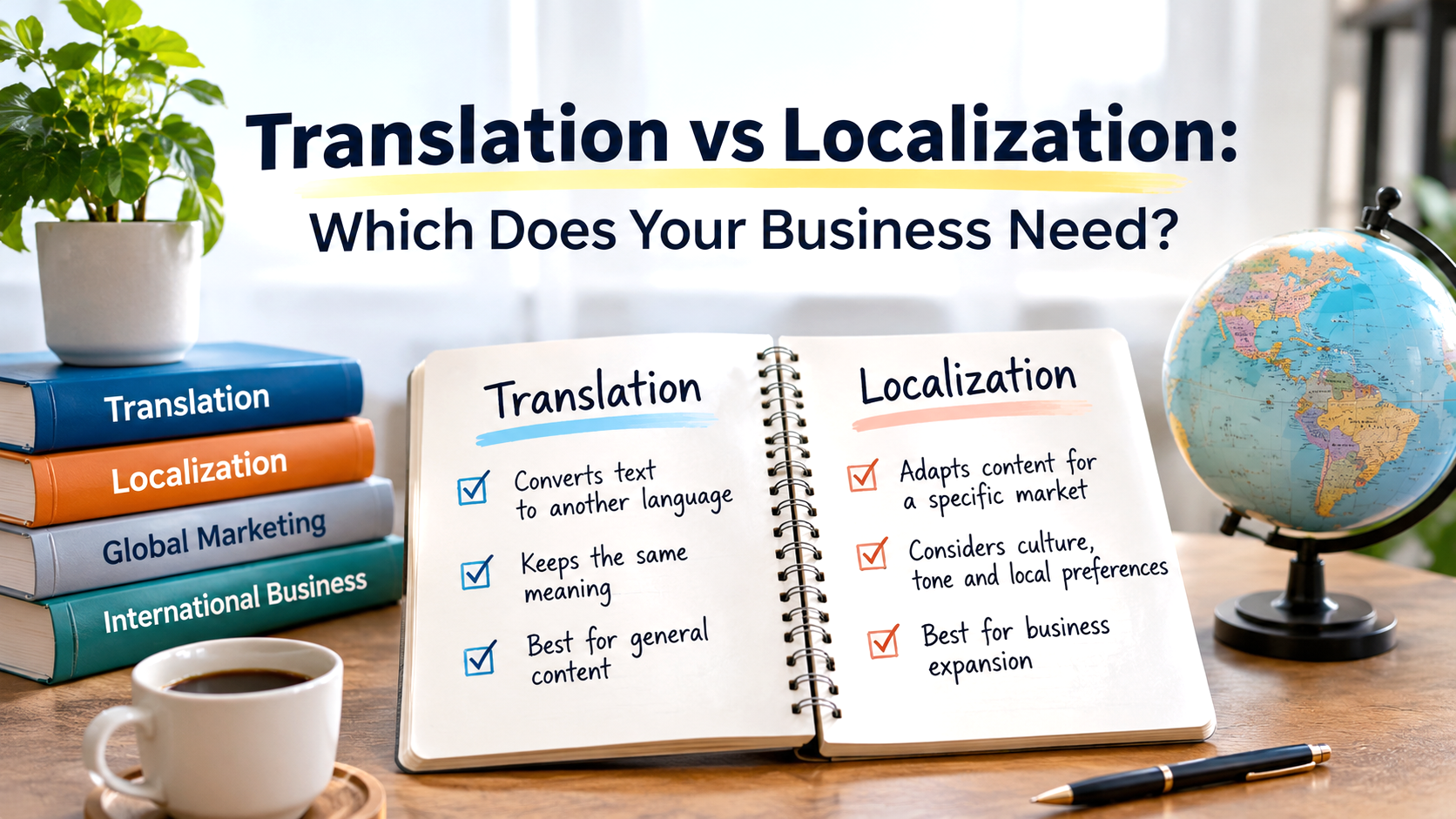
Expanding into a new market is exciting. Your product is ready, your team is motivated, and a whole new audience is waiting. Then comes the question every growing business faces: should you translate your content, or localize it?
Many people use the two words as if they mean the same thing. They don't. Picking the wrong one can cost you sales, damage trust, or leave customers confused about what you offer. In this guide, we explain the difference between translation and localization, when you need each, and how to choose the right approach for your business.
What Is Translation?
Translation is the process of converting text from one language into another while keeping its meaning accurate. A good translator does not swap words one by one. They understand the context, the tone, and the purpose of the original text, and then express the same message naturally in the target language.
Translation works best when the content is factual and the audience needs the information exactly as written. Common examples include:
- Legal contracts, agreements, and court documents
- Medical reports, clinical trial documents, and patient information
- Technical manuals and user guides
- Certificates, academic records, and official forms
- Financial statements and annual reports
In these cases, accuracy is everything. A single wrong term in a contract or a dosage instruction can create serious problems. That is why professional translation always relies on native-speaking linguists with subject-matter knowledge, not on machine output alone.
What Is Localization?
Localization goes a step further. It adapts your entire content, product, or experience so that it feels as though it was created for the local audience from the very beginning. Translation is one part of localization, but localization also covers:
- Cultural references: jokes, idioms, festivals, and examples that make sense locally
- Formats: dates, times, currencies, phone numbers, addresses, and units of measurement
- Visuals: images, colours, and symbols that suit local culture
- Design and layout: making room for longer text or right-to-left scripts such as Arabic and Urdu
- Legal and regional rules: local regulations, disclaimers, and privacy requirements
- Tone of voice: formal or friendly, depending on what the audience expects
For example, a marketing slogan that works well in English may sound strange, or even offensive, when translated word for word into Hindi, Tamil, or Japanese. Localization rewrites that slogan so it carries the same emotion and impact for the new audience.
Translation vs Localization: The Key Differences
| Translation | Localization | |
| Focus | Converting the words accurately | Adapting the whole experience |
| Goal | The reader understands the message | The reader feels the content was made for them |
| Scope | Text only | Text, images, formats, design, culture |
| Best for | Legal, medical, technical, official documents | Websites, apps, games, marketing, e-learning, video |
| Skills needed | Language and subject expertise | Language, cultural, and technical expertise |
In short: translation makes your content understandable; localization makes it relatable.
When Does Your Business Need Translation?
Choose translation when your content is informational and must stay faithful to the original. You need translation if:
- You are submitting documents to a government office, embassy, or court
- You need to share compliance, safety, or legal information with partners or staff
- Your technical documentation must match the source exactly
- You are translating research, reports, or internal communication
When Does Your Business Need Localization?
Choose localization when your goal is to connect with customers, build a brand, or drive sales in a new market. You need localization if:
- You are launching a website or mobile app in a new country or region
- You are releasing a video game for international players
- You are running advertising or social media campaigns for local audiences
- You are creating e-learning courses for learners in different regions
- You are publishing videos that need subtitles or voice-over that sounds natural
Why This Matters So Much in India
India is one of the most linguistically diverse countries in the world, with 22 officially recognised languages and hundreds of dialects. A customer in Chennai, a shopkeeper in Lucknow, and a student in Kolkata may all prefer content in different languages, and each region has its own culture, festivals, and way of speaking.
Businesses that speak to Indian customers in their own language build trust faster. Many people are more comfortable reading, shopping, and learning in their mother tongue, especially in smaller cities and rural areas. Simply translating English content into Hindi is often not enough. True localization adapts the message for each audience, whether that means using everyday spoken Hindi instead of formal textbook language, or choosing examples that feel familiar in Maharashtra or Punjab.
The same applies to Indian businesses going global. If you want to reach customers in the Middle East, Europe, or Southeast Asia, localization helps your brand feel local in every market.
Can You Use Both?
Yes, and most growing businesses do. A company might use translation for its contracts, product manuals, and compliance documents, and localization for its website, app, videos, and marketing campaigns. The smartest approach is to look at each piece of content and ask one simple question: Does the reader just need to understand this, or do they need to connect with it?
How Dhavan LangSoft Can Help
At Dhavan LangSoft Pvt. Ltd., we help businesses communicate clearly and confidently in more than 100 Indian and foreign languages. Our network of over 1,600 native linguists works across a wide range of services, including:
- Translation of legal, medical, technical, financial, and general documents
- Localization of websites, software, mobile apps, games, and e-learning content
- Voice-over and subtitling for videos, ads, films, and training content
- Transcription of audio and video in multiple languages
- Language Quality Assurance (LQA) to check accuracy, consistency, and cultural fit before launch
Every project follows a careful quality process, so your message stays accurate, natural, and true to your brand in every language.
Final Thoughts
Translation and localization are not competitors. They are two tools that work together. Translation gives your audience the right words, and localization gives them the right experience. Understanding the difference helps you spend your budget wisely and reach customers in a way that truly connects.
Need content translated or localized?
Native linguists in 100+ languages, a 3-team quality process and on-time delivery.